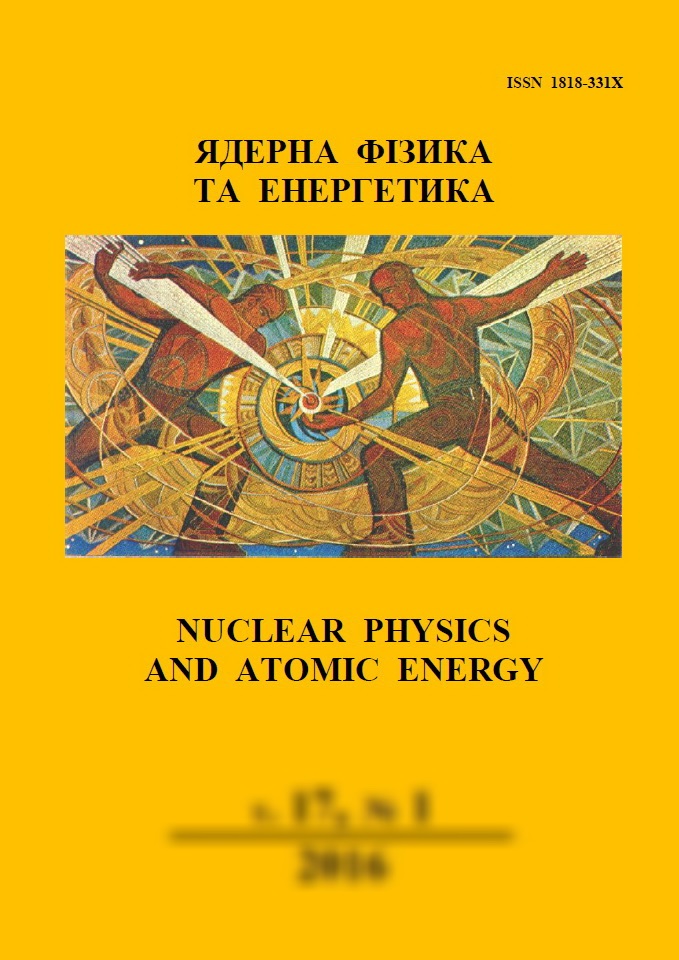
 |
Ядерна фізика та енергетика
Nuclear Physics and Atomic Energy
ISSN:
1818-331X (Print), 2074-0565 (Online)
Publisher:
Institute for Nuclear Research of the National Academy of Sciences of Ukraine
Languages:
Ukrainian, English
Periodicity:
4 times per year
Open access peer reviewed journal
|
Nucl. Phys. At. Energy 2025, volume 26, issue 4, pages 291-296.
Section: Nuclear Physics.
Received: 29.07.2025; Accepted: 26.11.2025; Published online: 29.12.2025.
 Full text (ua)
https://doi.org/10.15407/jnpae2025.04.291
Yields of rare earth element isotopes in the fission of actinide nuclei
V. T. Maslyuk*, P. S. Derechkei, Z. M. Bihan, P. P. Puha, N. I. Svatiuk, M. S. Liashov
Institute of Electron Physics, National Academy of Sciences of Ukraine, Uzhhorod, Ukraine
*Corresponding author. E-mail address:
volodymyr.maslyuk@gmail.com
Abstract:
The paper presents the results of studying the yields of rare earth element (REE) isotopes in the fission of heavy, particularly actinide, nuclei. Mass spectra of REE isotopes (samarium, dysprosium, holmium, ytterbium) were obtained for various fission scenarios of actinide nuclei (238U, 232Th, 241Am), both with and without accounting for nuclear particle emission, and at different excitation energies of the parent nucleus. Calculations were performed within the post-scission statistical approximation, which allows analyzing the statistical ordering of the two-fragment cluster ensemble. It is shown that the probabilities of REE isotope yields decrease with increasing atomic number, which may explain the peculiarities of their distribution in the Earth's crust. The presence of stable REE isotopes in trace amounts in the lithosphere can be attributed to specific features of spontaneous actinide fission accompanied by nuclear particle emission, which shifts the theoretical mass spectra toward stable REE isotopes.
Keywords:
rare earth elements, actinides, statistical method, fission fragments, mass spectra, yields, lithosphere.
References:
1. Wikipedia: Rare-earth element.
https://en.wikipedia.org/wiki/Rare-earth_element
2. P. Chen et al. Global rare earth element resources: A concise review. Appl. Geochem. 175 (2024) 106158.
https://doi.org/10.1016/j.apgeochem.2024.106158
3. Abundance of Elements in the Earth's Crust and in the Sea. In: CRC Handbook of Chemistry and Physics. 97th ed. Sect. 14, p. 17 (Boca Raton, FL, CRC Press, 2016 - 2017).
https://hbcp.chemnetbase.com/contents/ContentsSearch.xhtml?dswid=1788
4. A. Arcones, F.K. Thielemann. Origin of the elements. Astron. Astrophys. Rev. 31 (2023) 1.
https://doi.org/10.1007/s00159-022-00146-x
5. J.-F. Lemaître et al. Fission fragment distributions and their impact on the r-process nucleosynthesis in neutron star mergers. Phys. Rev. C 103 (2021) 025806.
https://doi.org/10.1103/PhysRevC.103.025806
6. V. Maslyuk, T. Kovács. The mapping of environmental radioactivity and new perspectives for ecology studies. In: V. Terrestrial Radioisotopes in Environment. International Conference on Environmental Protection (Hungary, Veszprem, 2016) p. 58.
https://doi.org/10.18428/TREICEP-2016
7. N.I. Svatiuk, V.T. Maslyuk, O.I Symkanich. Radiological monitoring, concept: "Radiation weather" and "Radiation identification of the environment". Uzhhorod University Scientific Herald. Series Physics 44 (2018) 99. (Ukr)
https://doi.org/10.24144/2415-8038.2018.44.99-108
8. V.T. Maslyuk et al. Transformations of actinides fission product yields due to post-scission emission of nuclear particles: 232Th. Canadian J. Phys. 99 (2021) 1007.
https://doi.org/10.1139/cjp-2020-0356
9. V.T. Maslyuk et al. New statistical methods for systematizing the nuclei fission fragments: Post-scission approach. J. Mod. Phys. 4 (2013) 1555.
https://doi.org/10.4236/jmp.2013.412191
10. M. Wang et al. The AME 2020 atomic mass evaluation (II). Tables, graphs and references. Chinese Phys. C 45 (2021) 030003.
https://doi.org/10.1088/1674-1137/abddaf
11. V.Yu. Denisov, V.A. Plujko. Problems of Atomic Nucleus Physics and Nuclear Reactions (Kyiv: Taras Shevchenko National University of Kyiv, 2013) 430 p. (Rus)
https://kinr.kyiv.ua/aspirant/docs/sc_ed_mat/Denisov_Plujko_Probl_Fiz_At_Yadr_Yader_Reakt.pdf